NC-9 R O Membrane
NC-9 R O Membrane
Couldn't load pickup availability
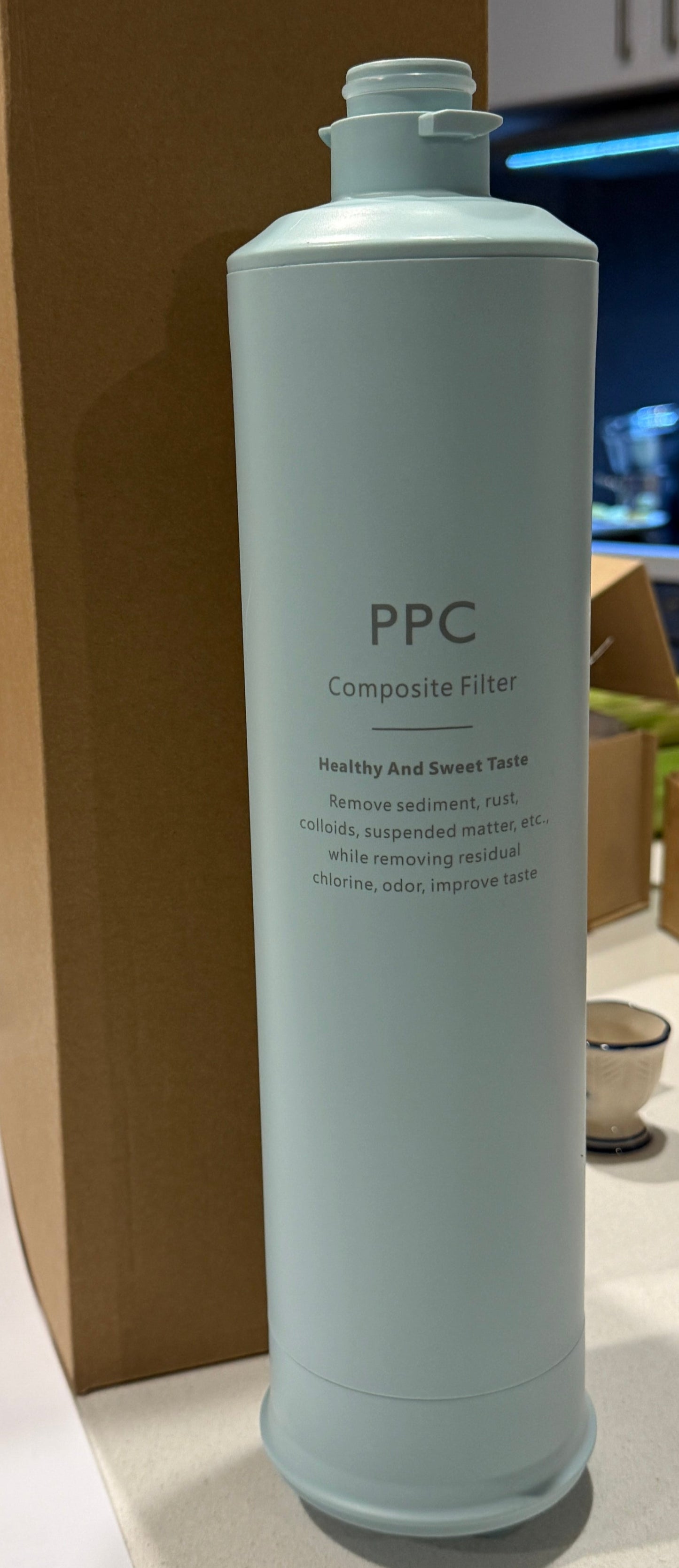
R O cartridge for the Nc9
RO elements use a thin-film composite (TFC) structure:
- A dense polyamide active layer (~0.1–0.2 microns thick)
- A porous polysulfone support layer
- A polyester backing for mechanical strength
The active polyamide layer is the actual separation barrier. It is not a simple “sieve.” It works by a solution–diffusion mechanism, not by visible pores you can measure with calipers.
1. Size exclusion (molecular sieving)
The effective free volume between polymer chains is extremely small (on the order of angstroms). Hydrated ions (Na⁺, Ca²⁺, Cl⁻, SO₄²⁻) are physically too large, once surrounded by their hydration shell, to diffuse easily through the polymer matrix.
Water molecules are much smaller and diffuse through more readily.
2. Charge repulsion (Donnan exclusion)
The polyamide layer carries a slight negative surface charge under normal operating pH.
- It repels negatively charged ions (e.g., Cl⁻, SO₄²⁻)
- Multivalent ions (Ca²⁺, Mg²⁺, SO₄²⁻) are rejected more strongly than monovalent ions (Na⁺, Cl⁻)
This electrostatic interaction significantly increases salt rejection efficiency.
3. Pressure-driven chemical potential gradient
You apply pressure greater than the natural osmotic pressure of the feed water.
- Pressure forces water molecules into the membrane surface.
- Water dissolves into the polymer matrix.
- Water diffuses across.
- Dissolved salts are left behind and flushed away in the concentrate stream.
It’s not “filtering” in the traditional sense. It’s a thermodynamically driven mass transfer process.
Typical performance
- Monovalent salt rejection: 95–99%
- Divalent salt rejection: 98–99.8%
- Bacteria/viruses: >99% rejection (size exclusion)
- Organics: depends on molecular weight and polarity
Share